- by E.T.
From Pharma to Farma: Humanity Isn’t Moving Forward… It’s Coming Home
*”The greatest discoveries are sometimes not new discoveries at all. Sometimes they’re old truths, remembered.”*
For most of human history, there were no pharmacies.
No synthetic compounds.
No bottles with impossible-to-pronounce ingredients.
There were forests.
Mountains.
Oceans.
Roots.
Leaves.
Seeds.
Fungi.
Resins.
Minerals.
There was observation.
There was trial and error.
There were grandparents passing knowledge to grandchildren, healers teaching apprentices, civilizations documenting remedies on stone tablets, papyrus, bamboo scrolls and parchment long before the first laboratory ever existed.
For thousands of years, humanity’s medicine cabinet wasn’t built…
It was grown.
—
## Then We Forgot.
The Industrial Revolution transformed nearly every aspect of human life.
It gave us electricity, automobiles, antibiotics, computers, modern surgery, vaccines, organ transplants and countless medical breakthroughs that have saved hundreds of millions of lives.
Modern medicine is one of humanity’s greatest achievements.
But somewhere along the way, many of us began believing that the newest solution was automatically the best solution.
The old ways became dismissed as primitive.
Ancient herbs became “alternative.”
Traditional nutrition became folklore.
The forest became something to admire…
Instead of something that had always helped sustain us.
—
## But Something Changed.
Over the past decade, a quiet revolution has been taking place.
It didn’t begin in government offices.
It wasn’t created by billion-dollar pharmaceutical companies.
It started with ordinary people asking simple questions.
*”Why am I always tired?”*
*”Why don’t I sleep well anymore?”*
*”What am I eating?”*
*”What did people do before all of this?”*
Those questions have sparked one of the fastest-growing wellness movements in modern history.
Today, the global dietary supplement industry is valued at well over **$150 billion**, with many analysts projecting it could surpass **$400 billion** within the next decade.
In the United States alone, more than **half of all adults** now take dietary supplements.
That isn’t a fad.
That’s a cultural shift.
—
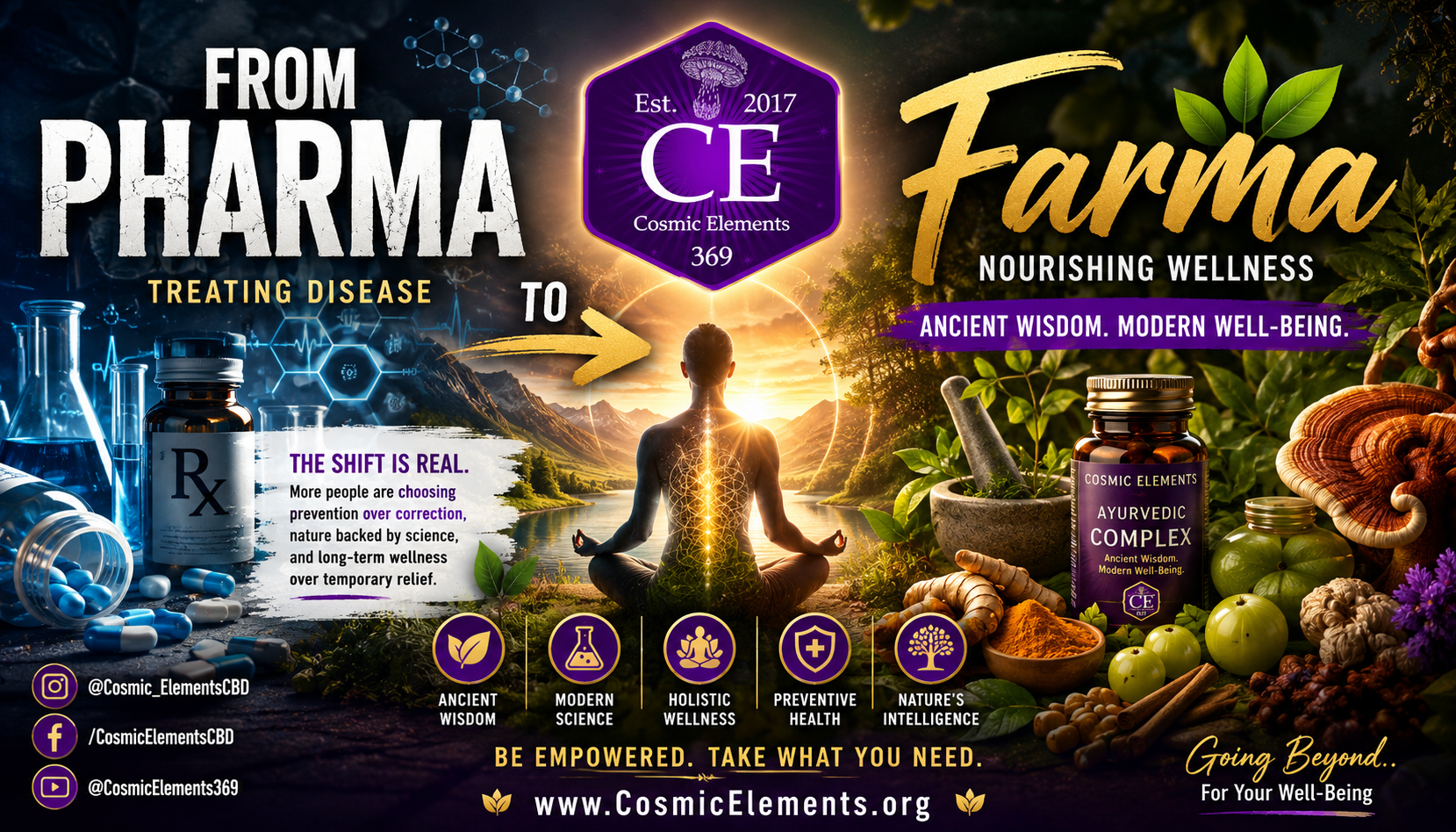
## From Pharma… to Farma.
At Cosmic Elements, we like to think of it this way.
Not **Pharma versus Farma.**
But **Pharma and Farma.**
Modern medicine is extraordinary when something has already gone wrong.
Nature is extraordinary in helping us care for ourselves before it does.
One saves lives in emergencies.
The other helps millions pursue healthier ones every day.
The smartest future isn’t choosing one side.
It’s learning when each belongs.
—
## Ancient Doesn’t Mean Outdated.
Some of the herbs people are discovering today aren’t new at all.
Ashwagandha has been part of Ayurvedic tradition for over **3,000 years.**
Traditional Chinese Medicine has documented botanical therapies for more than **2,500 years.**
Medicinal mushrooms like reishi have earned nicknames such as **”The Mushroom of Immortality”** after centuries of use throughout East Asia.
Turmeric has been cultivated and valued for thousands of years.
Garlic has appeared in Egyptian writings dating back more than **3,500 years.**
Olive oil was treasured throughout the Mediterranean before many nations even existed.
These weren’t internet trends.
These were civilizations.
Entire cultures invested generations observing what helped people thrive.
Today, science has the opportunity to examine that knowledge with tools those civilizations never possessed.
Sometimes it confirms ancient wisdom.
Sometimes it challenges it.
Either outcome is progress.
—
## Science Isn’t Replacing Nature.
It’s Translating It.
For the first time in history, researchers can identify individual plant compounds.
Measure inflammation markers.
Analyze the microbiome.
Observe antioxidant activity.
Study neurotransmitters.
Map genetic pathways.
What ancient healers learned through centuries of careful observation…
Scientists can now investigate under microscopes.
These are not opposing worlds.
They’re two chapters of the same story.
—
## The Human Body Hasn’t Changed Nearly As Much As Our Lifestyle.
Our ancestors walked miles every day.
Worked outdoors.
Experienced natural light from sunrise to sunset.
Ate foods that were largely unprocessed.
Slept according to the rhythms of the sun.
Today?
Many of us spend our days sitting.
Looking at screens.
Living under artificial light.
Sleeping too little.
Managing chronic stress.
Eating foods our great-grandparents wouldn’t recognize.
Our environment has changed faster than our biology.
Perhaps that’s one reason so many people are searching for ways to better support their health.
—
## Take What You Need.
Not What Everyone Else Is Taking.
Supplements should never become another form of consumerism.
More bottles do not equal more health.
Your body isn’t missing every nutrient on the shelf.
Some people need support for sleep.
Others for digestion.
Others for cardiovascular health.
Some simply want to fill nutritional gaps created by busy modern lives.
The goal isn’t to own supplements.
The goal is to understand yourself.
The smartest supplement is often the one you actually need.
Not the one with the loudest advertisement.
—
## The Return Has Already Begun.
This movement isn’t really about vitamins.
It isn’t about mushrooms.
Or collagen.
Or probiotics.
It’s about something much larger.
People are remembering that health isn’t manufactured.
It’s cultivated.
One decision at a time.
One meal.
One walk.
One night of better sleep.
One conversation.
One habit.
One carefully chosen supplement that supports—not replaces—a healthy lifestyle.
For generations, humanity looked almost exclusively toward chemistry for answers.
Now, more and more people are looking back toward biology.
Toward plants.
Toward nutrition.
Toward prevention.
Toward balance.
Not because they’re rejecting science.
But because science is increasingly validating what many ancient cultures quietly understood all along.
Perhaps humanity isn’t moving backward.
Perhaps we’re finally completing the circle.
Learning that the future of wellness doesn’t belong to pharmaceuticals alone.
Nor to ancient herbs alone.
It belongs where knowledge has always been strongest…
Where wisdom and science meet.
Welcome home.
-ET
—
### Sources & Further Reading
* National Institutes of Health – Office of Dietary Supplements (ODS)
* World Health Organization (WHO) – Traditional, Complementary and Integrative Medicine
* National Center for Complementary and Integrative Health (NCCIH)
* *A Global Overview of Dietary Supplements: Regulation, Market Trends, Usage, and Future Perspectives* (2023)
* Grand View Research – Global Dietary Supplements Market Report