- by E.T.
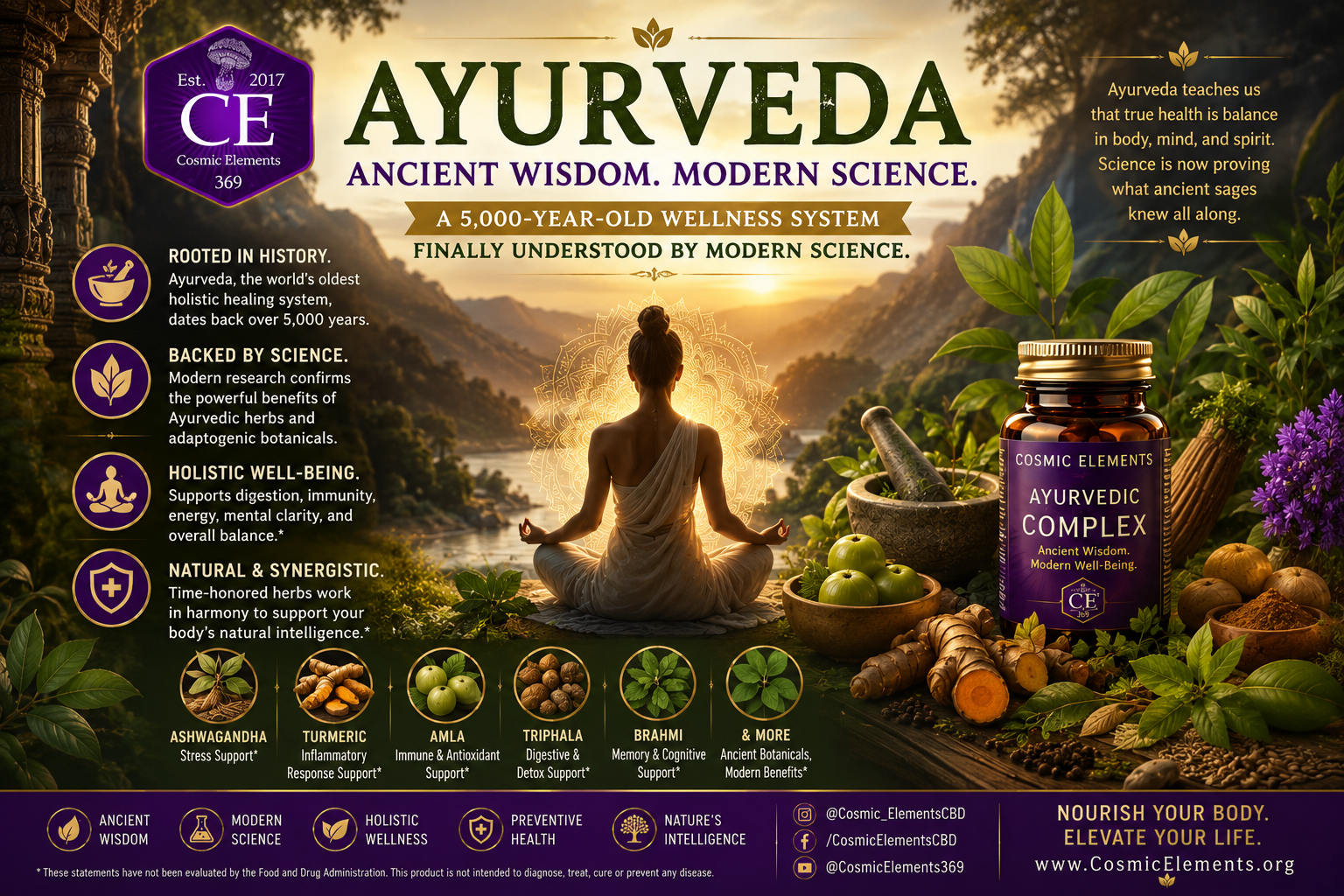
# Ayurveda: A 5,000-Year-Old Wellness System That Modern Science Is Finally Beginning to Understand
*”Not every breakthrough is a new invention. Sometimes it’s an ancient idea viewed through a modern microscope.”*
Long before wellness became an industry, before nutrition labels, laboratories, or dietary supplements, there was Ayurveda.
Originating in India more than **5,000 years ago**, Ayurveda—derived from the Sanskrit words *Ayur* (life) and *Veda* (knowledge or science)—is one of the world’s oldest continuously practiced systems of health. Its philosophy is remarkably simple: health is not merely the absence of disease, but the result of balance between the body, mind, environment, nutrition, and daily habits.
While modern medicine has transformed emergency care and disease treatment, Ayurveda has always focused on something equally important: supporting the body’s natural ability to maintain wellness before problems arise.
Today, thousands of years later, researchers are beginning to examine many of Ayurveda’s traditional botanicals using the tools of modern science.
Interestingly, they’re finding that many of these plants contain biologically active compounds that may help explain why they have remained trusted for centuries.
—
## A System Built on Synergy
One of Ayurveda’s most fascinating ideas is that health isn’t usually restored by a single ingredient.
Instead, carefully selected herbs work together, each supporting different systems while complementing one another.
Modern pharmacology often calls this **synergy**.
Ayurveda has practiced it for millennia.
Rather than overwhelming the body with a single approach, traditional Ayurvedic formulations were designed to support digestion, resilience, mental clarity, energy, and overall vitality simultaneously. That holistic philosophy remains one of the defining characteristics of Ayurvedic medicine today.
—
## Ancient Herbs, Modern Research
Many of the herbs used in Ayurvedic formulations have become the subject of growing scientific interest.
**Ashwagandha (Withania somnifera)** is perhaps the best known. Considered an adaptogen in Ayurvedic tradition, it has been investigated in multiple clinical studies for its ability to help the body adapt to stress. Systematic reviews have found evidence that standardized ashwagandha extracts may reduce perceived stress and cortisol levels while also supporting sleep quality in some adults.
**Turmeric**, prized for centuries in both cooking and traditional wellness practices, contains curcuminoids—most notably curcumin—which have been extensively studied for their antioxidant activity and their role in supporting the body’s normal inflammatory response. Scientists continue to investigate its potential applications in joint health, cardiovascular wellness, and healthy aging.
**Triphala**, a classic blend of three fruits—Amla (*Emblica officinalis*), Bibhitaki, and Haritaki—has traditionally been used to support digestion and regularity. Modern laboratory and early clinical research suggests Triphala possesses antioxidant properties and may support gastrointestinal health, although larger clinical trials are still needed.
**Amla**, also known as Indian Gooseberry, is naturally rich in vitamin C and polyphenols. Research has explored its antioxidant capacity and potential role in supporting immune function, healthy cholesterol levels, and cellular protection from oxidative stress.
**Brahmi (Bacopa monnieri)** has been revered in Ayurveda for centuries as a botanical that supports memory and mental clarity. Modern research has investigated standardized extracts for cognitive performance, particularly memory and information processing, with several studies reporting promising—though still evolving—results.
—
## Why Digestion Is So Central to Ayurveda
One concept that often surprises people is Ayurveda’s emphasis on digestion.
Traditional Ayurvedic practitioners believed that how well we digest and absorb nutrients influences nearly every aspect of health—from energy and resilience to skin appearance and overall vitality.
Modern science approaches this idea from a different angle, but arrives at a similar appreciation for digestive health. Researchers now recognize the importance of the gut microbiome, nutrient absorption, and the intricate communication between the digestive system, immune system, and brain.
While the language has changed over thousands of years, the central idea has remained remarkably consistent: a healthy digestive system is foundational to overall well-being.
—
## Nature Meets Evidence
The beauty of Ayurveda isn’t that every traditional belief has been scientifically proven.
It hasn’t.
Nor should we expect a medical tradition developed thousands of years ago to have every answer.
What makes Ayurveda remarkable is that many of its foundational herbs continue to attract serious scientific attention because researchers keep finding compounds worthy of investigation.
That’s how science should work.
Not accepting every tradition without question.
Not dismissing ancient knowledge because it’s old.
But allowing careful research to test ideas that have endured across generations.
—
## Choosing Supplements With Purpose
One of the greatest misconceptions about supplements is that more is always better.
It isn’t.
The goal isn’t to fill your cabinet with bottles.
It’s to thoughtfully support your body’s individual needs.
A well-designed Ayurvedic formula isn’t about chasing the latest trend or miracle ingredient. It’s about combining botanicals that have complemented one another for centuries while choosing products made with quality ingredients and responsible manufacturing practices.
As always, supplements should complement—not replace—a balanced diet, healthy lifestyle, and appropriate medical care. If you’re pregnant, nursing, taking medications, or managing a medical condition, consult your healthcare provider before adding new supplements to your routine.
—
## Ancient Wisdom. Modern Well-Being.
For more than five millennia, Ayurveda has taught that health is something we cultivate each day—not something we only think about when it’s lost.
Today, scientific research continues to explore many of its traditional botanicals, offering new insight into practices that have endured across generations.
Perhaps that’s why Ayurveda continues to resonate with so many people.
Not because it’s ancient.
But because its central message is timeless.
When we nourish the body, calm the mind, respect nature, and pursue balance instead of extremes, wellness becomes more than a destination.
It becomes a way of life.
—
### References
* National Center for Complementary and Integrative Health (NCCIH). *Ayurvedic Medicine: In Depth.*
* Johns Hopkins Medicine. *Ayurveda: What It Is and How It Works.*
* Jaiswal YS, Williams LL. *A Glimpse of Ayurveda – The Forgotten History and Principles of Indian Traditional Medicine.* Journal of Traditional and Complementary Medicine (2017).
* Reviews of ashwagandha, turmeric, Triphala, Amla, and Brahmi summarized in evidence-based nutrition literature.