- by E.T.
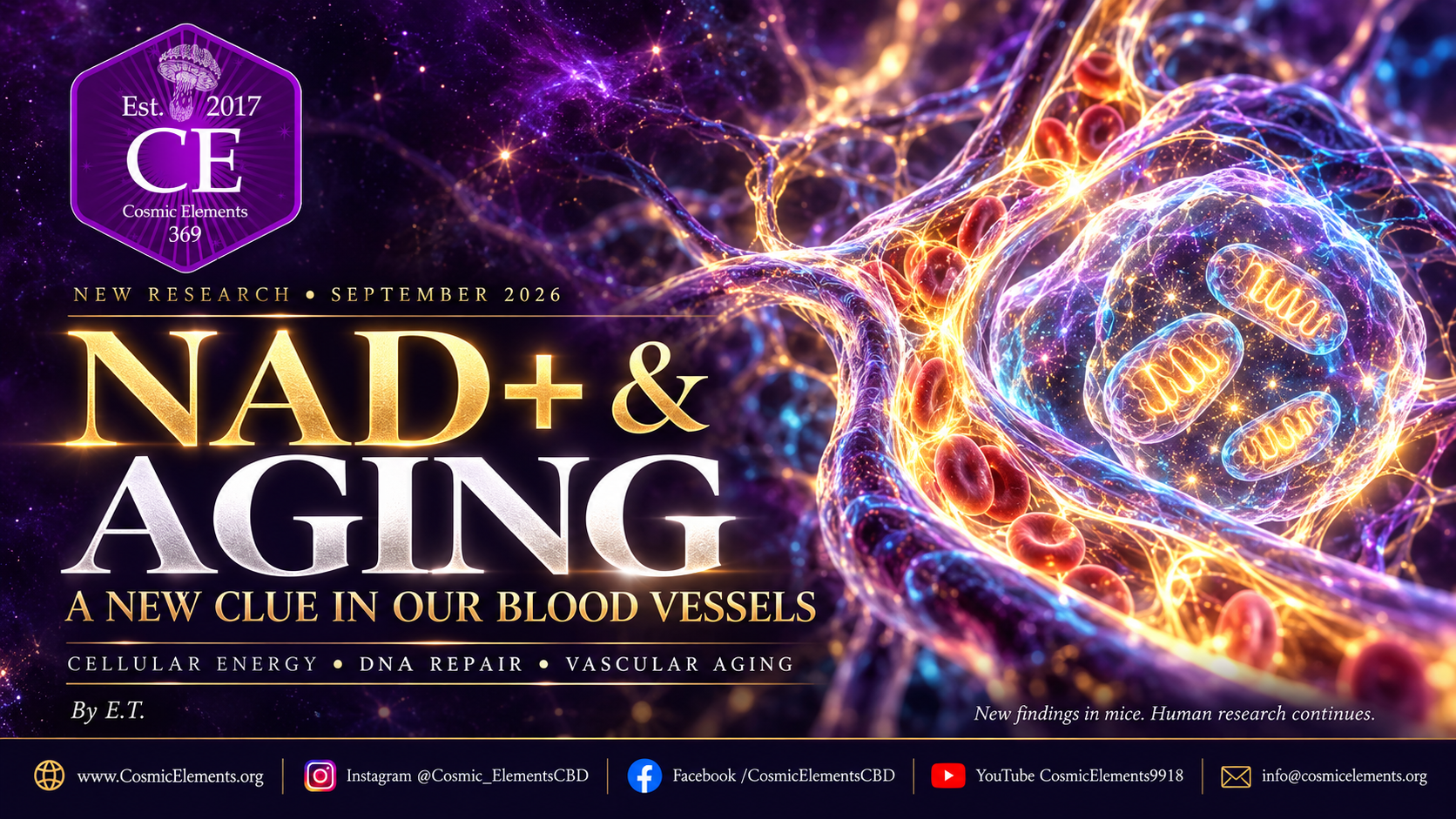
Research on NAD+ and aging starts with its role in cellular energy and repair. Now, a September 2026 study puts the cells lining our blood vessels in the spotlight—and raises a new question about why the body’s NAD+ production can falter.
By E.T. | Cosmic Elements
What we already know about NAD+ and aging
Nicotinamide adenine dinucleotide, or NAD+, is a coenzyme found in cells. First, its NAD+/NADH cycle transfers electrons in metabolic reactions. As a result, cells can extract usable energy from nutrients. In addition, it supplies enzymes involved in DNA damage responses and the regulation of cellular activity, including PARPs and sirtuins. [3]
That explains the interest in NAD+ and aging: researchers are investigating how changes in its production, consumption, and availability affect cellular resilience. However, its distribution across tissues and compartments matters. Therefore, a single blood measurement cannot describe everything happening inside the body. [3]
For example, human research has already established that some precursors can raise blood NAD+. In a 2019 randomized trial, oral NR increased whole-blood NAD+ in a dose-dependent manner over eight weeks. Thus, the trial demonstrates a biochemical effect. However, lasting improvements in health or lifespan remain separate questions. [4]
New intel on NAD+ and aging: blood vessels
Now, a paper published online September 16, 2026, in Science Advances connects disruption of NAD+ production in blood vessel cells with aging throughout the body. However, the findings come primarily from experimental mouse models. Therefore, they offer an emerging research story rather than proof of a human longevity treatment. [1]
What the new NAD+ study found
Researchers identified a pathway called C/EBPβ/AEP that became more active in aging endothelial cells—the cells lining blood vessels. Specifically, AEP cut an enzyme called NAMPT. As a result, this impaired a key route for making NAD+. In the models studied, this was linked to NAD+ depletion, cellular senescence, and vascular dysfunction. [1]
Protecting NAMPT from this damage or genetically removing AEP improved vascular aging. In addition, these interventions extended lifespan in a specific genetically engineered mouse model. Meanwhile, NMN supplementation and an experimental AEP inhibitor, CP#11A, alleviated vascular decline. However, the inhibitor performed better. Crucially, these were different interventions. Therefore, the lifespan finding should not be presented as proof that NMN makes people live longer. [1]
Why NAD+ and aging research is changing
As a result, our interpretation is that this work gives researchers a reason to ask two questions together. First, can they replenish a depleted molecule, and can they protect the machinery responsible for producing it?
For example, imagine replenishing supplies in a workshop while also investigating why its production equipment keeps breaking down. In turn, the second task may help explain why the first delivers lasting results. Therefore, this analogy illustrates the research direction. However, it does not predict a supplement’s effectiveness.
NAD+, NMN, and NR are different
NAD+ is involved in cellular energy metabolism. NMN and nicotinamide riboside, or NR, are precursors used in pathways that produce NAD+. However, a study of one precursor cannot automatically establish the benefits of another precursor, oral NAD+, or an NAD+ infusion. [1,2]
Consequently, the ingredient, delivery method, population, and measured outcome all matter when interpreting a headline.
What a 2026 human trial adds
A separate randomized trial published in The Lancet Neurology in May 2026 evaluated NR, individualized exercise, and their combination in people with Friedreich’s ataxia. In this trial, the combination improved the primary fitness outcome compared with the control group. However, NR alone did not produce a statistically significant improvement on that outcome. [2]
Nevertheless, that disease-specific trial does not establish an anti-aging benefit in healthy adults. Instead, it illustrates why a promising biological mechanism needs testing against outcomes that matter to people.
Reading the next NAD+ and aging headline
Finally, before treating a discovery as a reason to buy, ask:
- Was the intervention tested in people, animals, or isolated cells?
- Was the result a change in a biomarker, physical function, or lifespan?
- Does the actual ingredient match the one discussed in the headline?
At Cosmic Elements, we follow emerging wellness science with curiosity and attention to the evidence. Explore our supplement collection. Also, read each product’s ingredient panel and directions when considering how it fits your routine.
This article is educational and does not establish benefits for any Cosmic Elements product.
Sources
- Li B, et al. Endothelial C/EBPβ/AEP pathway drives vascular deterioration and systemic aging. Science Advances. Published online September 16, 2026. DOI: 10.1126/sciadv.aed1961. PubMed record.
- Lin KY, et al. Safety and efficacy of individualised exercise and NAD+ precursor supplementation in patients with Friedreich’s ataxia in the USA: a single-centre, 2 × 2 factorial, randomised controlled trial. The Lancet Neurology. May 2026;25:469–481. Study DOI.
- The role of NAD+ metabolism and its modulation of mitochondria in aging and disease. npj Metabolic Health and Disease. 2025;3:26. Review.
- Safety and Metabolism of Long-term Administration of NIAGEN (Nicotinamide Riboside Chloride) in a Randomized, Double-Blind, Placebo-controlled Clinical Trial of Healthy Overweight Adults. 2019. PubMed record.