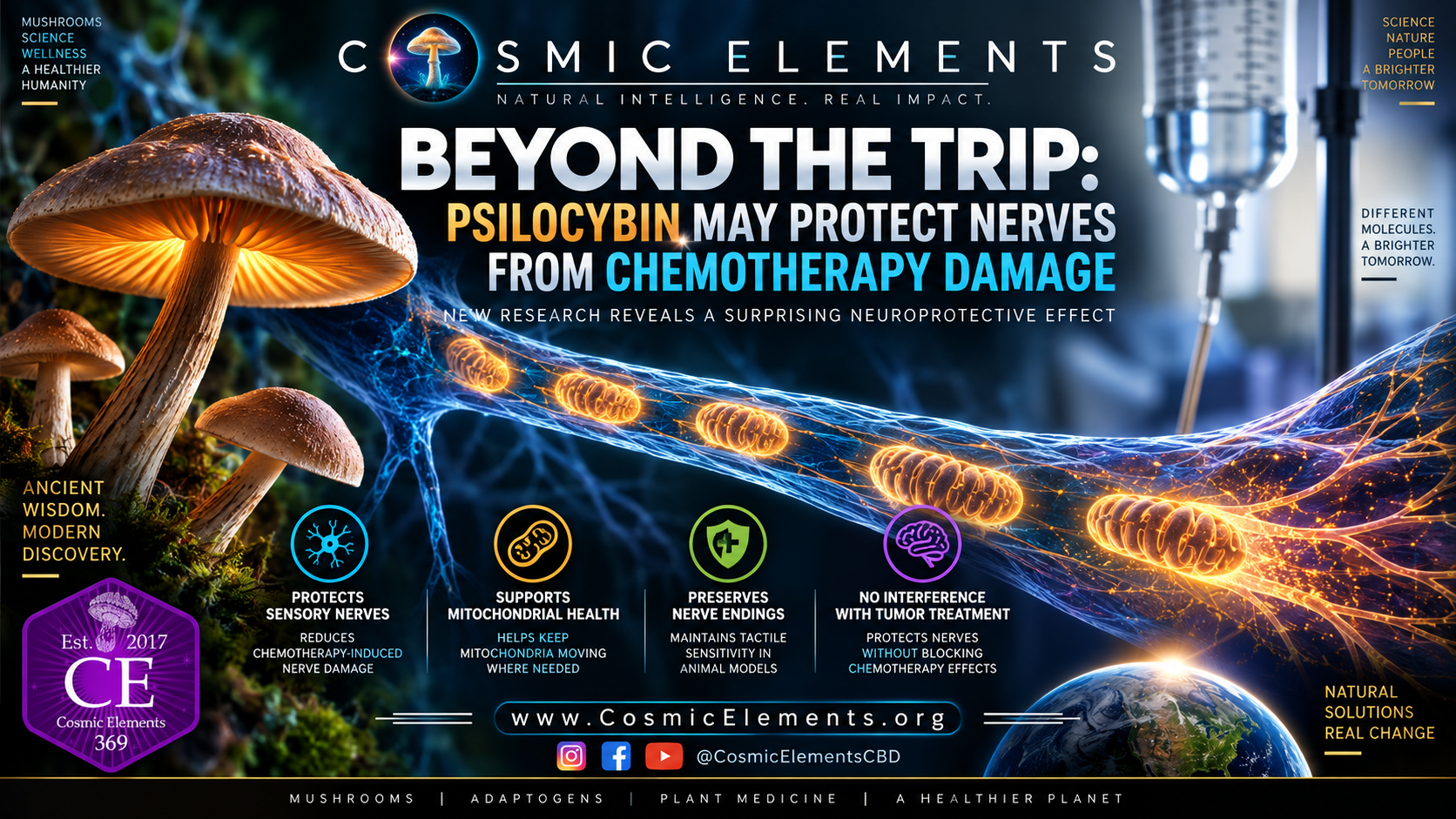
- by E.T.
For decades, psilocybin — the naturally occurring psychedelic compound found in certain mushroom species — has been discussed mainly for its effects on the mind.
Altered perception. Changes in consciousness. Mystical experiences. More recently, researchers have explored its potential role in depression, anxiety, and other psychiatric conditions.
But fascinating new research points in an entirely different direction.
A study published in *Science* found that psilocybin protected sensory nerves in mice from damage caused by chemotherapy. The discovery opens a surprising new area of **psilocybin chemotherapy nerve damage** research.
Even more interesting is *how* that protection may work.
The answer appears to involve mitochondria — the tiny structures responsible for supplying cells with much of their usable energy.
Why Chemotherapy Can Damage Peripheral Nerves
Peripheral neuropathy occurs when nerves outside the brain and spinal cord become damaged.
Certain chemotherapy drugs are particularly known for this complication. Patients may experience burning, tingling, numbness, hypersensitivity, or chronic pain. In some cases, these symptoms can continue long after cancer treatment ends.
Sensory neurons face an unusual biological challenge because of their extraordinary shape.
A single neuron can extend an axon across a huge distance relative to the size of its cell body. The nerve must supply energy all the way to those distant endings.
That’s where mitochondria become critical.
Mitochondria are often called the cellular “powerhouses” because they help generate the energy cells need. But neurons don’t simply need to produce energy. They also need to move mitochondria to the places where that energy is required.
Chemotherapy can interfere with this transportation system.
When mitochondrial movement and distribution break down, distant nerve endings may become vulnerable. Eventually, those nerve endings can deteriorate.
The new research suggests psilocybin may help prevent that process.
Psilocybin Protected Nerves During Chemotherapy
Researchers gave psilocybin to mice before chemotherapy.
In the experimental models, as few as two doses before chemotherapy produced lasting protection against chemotherapy-induced peripheral neuropathy.
That protection continued across repeated chemotherapy cycles.
Compared with untreated animals, mice that received psilocybin maintained better tactile sensitivity. Researchers also found greater preservation of sensory nerve endings in the skin.
The scientists went one important step further. They studied what happened in animals with tumors.
Psilocybin’s neuroprotective effects did not appear to stop chemotherapy from attacking those tumors.
That’s a crucial distinction.
A treatment that protects healthy nerves would have limited value if it also shielded cancer cells from chemotherapy. In these animal experiments, researchers did not observe that problem.
The Mitochondrial Connection
This may be the most intriguing part of the study.
Researchers found evidence that psilocybin preserved the movement and distribution of mitochondria along sensory axons.
The effect involved a molecular signaling pathway that included proteins such as TrkB, Akt, PAK5, MAP2, and KIF5B. Through this pathway, psilocybin helped mobilize mitochondria that might otherwise become anchored in place.
In simpler terms, chemotherapy can disrupt a neuron’s energy-delivery network.
**Psilocybin appears to help keep that network moving.**
Maintaining mitochondrial distribution may allow neurons to deliver energy to distant nerve endings more effectively. That could help those structures survive chemotherapy-related stress that might otherwise cause them to deteriorate.
This suggests the effect goes beyond temporarily reducing the sensation of pain.
The researchers found evidence of actual nerve preservation.
What Happened Inside the Brain?
The researchers also observed changes within the central nervous system.
Psilocybin helped normalize activity in the medial prefrontal cortex. Researchers also observed changes involving alpha- and beta-frequency brain activity.
These findings add another layer to the story.
The compound appears to influence several aspects of nervous-system function while also protecting peripheral sensory structures.
That combination deserves much more investigation.
The Protection May Not Require a Psychedelic Trip
Then came another fascinating result.
Researchers also tested **tabernanthalog**, a non-hallucinogenic compound designed to activate related biological pathways.
It produced similar protection against sensory nerve loss and pain hypersensitivity in the animals.
That raises an intriguing possibility.
Scientists may eventually be able to separate some therapeutic properties associated with psychedelic compounds from the psychedelic experience itself.
In other words, altering consciousness may not always be necessary to tap into the underlying biology.
If future research supports that idea, it could significantly expand the types of medicines scientists develop from psychedelic-inspired chemistry.
Mushrooms Are Remarkable Chemical Laboratories
At Cosmic Elements, this is part of what makes fungi so endlessly fascinating.
A mushroom isn’t simply a food, supplement, or psychedelic.
It’s a living chemical laboratory.
Fungi produce an extraordinary collection of molecules shaped by hundreds of millions of years of evolution. Scientists are still discovering what many of these compounds can do.
Fungal compounds have already played important roles in modern medicine. Continuing research into psilocybin reminds us that a molecule known for one dramatic effect may influence entirely different biological systems.
In this case, scientists investigated a compound famous for changing perception and uncovered something unexpected.
They found a potential connection between **nerve survival, mitochondrial movement, and cellular energy management.**
That’s a much bigger biological story than simply asking whether someone “trips.”
Preventing Nerve Damage Instead of Repairing It
The study also highlights a broader idea in medicine: prevention may sometimes be more effective than repair.
Much of medicine focuses on treating damage after it happens.
But neurons can be extraordinarily difficult to restore once their axons and nerve endings have deteriorated.
These researchers approached the problem differently.
Could vulnerable neurons become more resilient **before** chemotherapy damages them?
In these animal models, the answer appears promising.
That shift — from repairing nerve damage to preserving biological resilience — could eventually have implications beyond chemotherapy.
Scientists may discover new therapeutic targets by studying the mechanisms that control mitochondrial movement, cellular energy balance, and nerve survival.
Whether those mechanisms can help address other forms of peripheral nerve degeneration remains an open question.
But it’s an exciting one.
What This Study Does — and Doesn’t — Tell Us
There’s an important limitation.
**This research was conducted in animal models.**
The findings do not prove that psilocybin prevents chemotherapy-induced peripheral neuropathy in humans. They also don’t establish a safe or effective human dose.
And they certainly don’t mean that someone undergoing chemotherapy should begin taking psychedelic mushrooms on their own.
Cancer treatment involves complex interactions between medications, physiology, and disease. Psychedelic compounds can introduce additional medical and psychological considerations.
Human clinical trials will be necessary to determine whether this protective effect translates from mice to people.
For now, the study gives researchers something extremely valuable: a biological mechanism worth investigating.
The Bigger Picture
Perhaps the most exciting part of this research isn’t psilocybin itself.
It’s what psilocybin helped scientists uncover.
Neurons are incredibly energy-intensive structures. Their survival depends on more than simply producing energy. They also need to deliver cellular power supplies to the right place at the right time.
A molecule produced by a mushroom appears capable of influencing that transportation system in experimental animals.
The result was striking: nerve endings showed greater protection from chemotherapy-induced degeneration.
That creates an unexpected connection between fungal chemistry, mitochondrial biology, cancer treatment, and neuroscience.
It also raises a much larger question.
How many other natural compounds have biological capabilities that science hasn’t yet discovered?
Nature has spent billions of years experimenting with chemistry.
We’re still learning how to read the results.
**And sometimes, the most interesting thing about a psychedelic isn’t the trip at all.**
Sources & Further Reading
Heles M., Pasvolsky L., Sathishkumar H. et al. *Psilocybin prevents chemotherapy-induced peripheral neuropathy through mitochondrial trafficking preservation.* *Science*. 2026;393(6815):eaec6116. DOI: 10.1126/science.aec6116.
Kozlov M. *Magic-mushroom compound blocks a severe side effect of chemotherapy in mice.* *Nature*. September 3, 2026.
**Disclaimer:** This article is for educational and informational purposes only and does not constitute medical advice. Psilocybin remains a controlled substance in many jurisdictions. The research discussed here involved preclinical animal models and should not be interpreted as support for self-treatment or changes to prescribed cancer therapy.